By Sophie Crocker ARB, EDAC, WELL AP, White Arkitekter and Co-Opted Member, Architects for Health Executive.
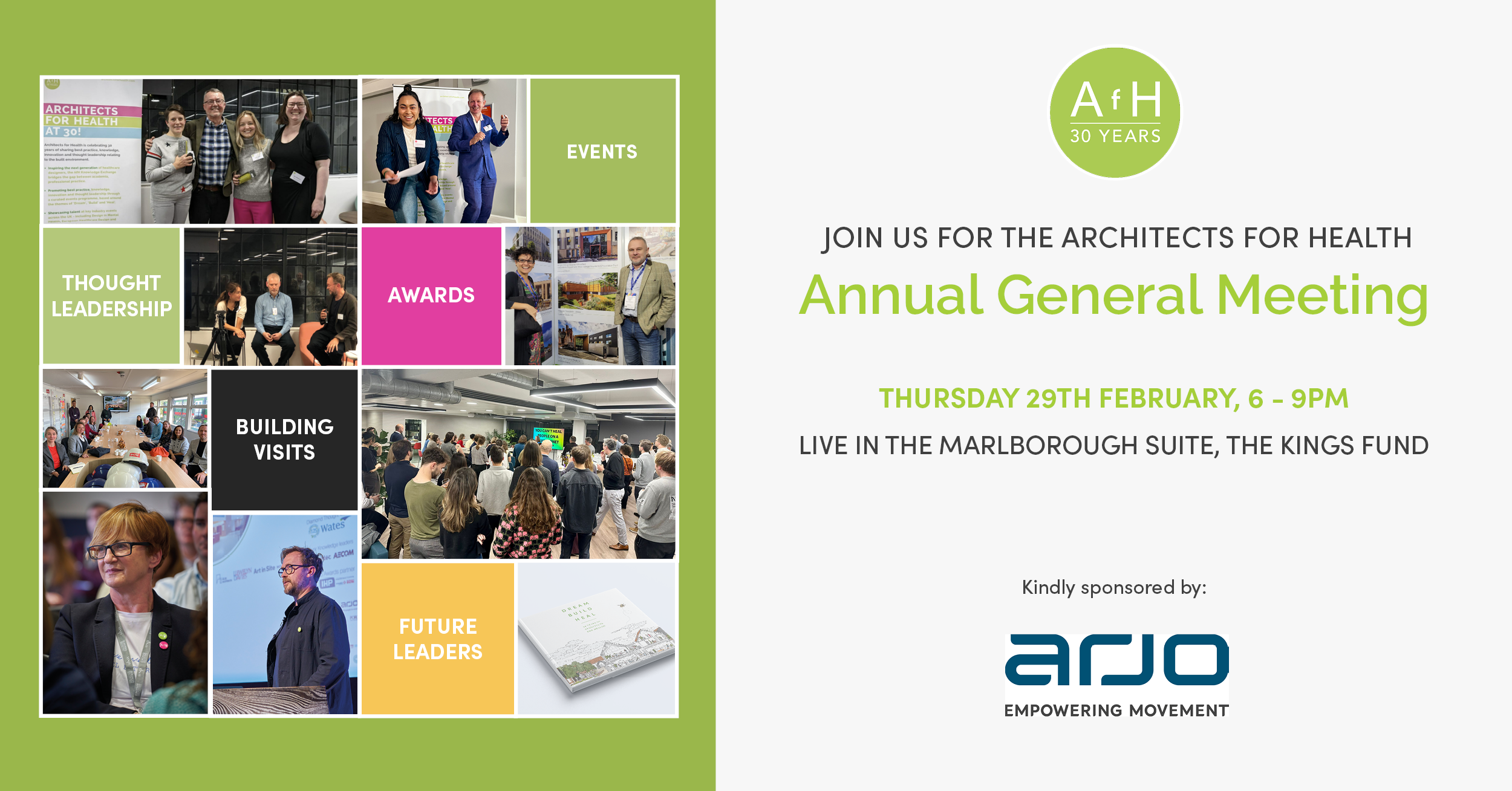
In February 2024, Architects for Health (AfH) held its Annual General Meeting (AGM). Concluding our 30th year, Chair Jaime Bishop’s review celebrated growth (and the successful implementation of free NHS membership); strength and depth (in activity, thought leadership and advocacy), and the publication of ‘Dream Build Heal’ – our 30th anniversary book.
Jaime also thanked Steph Williamson for her work and profound contribution as Co-Chair for the past two years as she steps down.
Formalities over, we moved to the Phil Gusack talk. With a reputation for challenging preconceptions and lively debate, this year was no exception. Panellists, Simon Corben, Duane Passman, Sylvia Wyatt and Beatrice Fraenkel were invited to expand on opinion pieces published in the book, and the floor was opened to questions.
Here’s what we heard.
Primary and social care play a vital role in tackling demographic and health trends.
There is a huge opportunity to re-use empty high street store fronts. Cross government policy is encouraging collaborative working “at pace,” to bring economic and health benefits to communities. As Beatrice Fraenkel noted, new models of care disengage where healthcare takes place from the physical spaces, we are historically familiar with.
Place the focus on people, not buildings.
Addressing the pressures faced by our healthcare workforce is central to developing estates solutions for the future, and potentially at odds with NHP criteria (particularly for single-bed rooms), which could exacerbate pressure. Beatrice observed, when guidance was developed, the NHS was not facing the workforce challenges it is today.
“You cannot look at the building as the end product – if you want to look at flexibility, adaptability and sustainability – we need to focus on the people not the buildings.”
Sylvia Wyatt
Furthermore. emerging technologies present an opportunity to switch to moving information rather than people around the system. Digital healthcare (and the rise of AI) is a catalyst for change and may even offer opportunities to re-use, repurpose and downscale buildings previously thought redundant.
Returning to a rhythm of capital investment.
“We need to be smart with capital, get back to the core principles with an updated Estates Code and a long-term infrastructure plan.”
Simon Corben
A newly launched ICS Estates Strategy Programme, supported by planning guidance and emerging Local Development Control Plans (DCPs) will help focus investment outside of the ‘40’ new hospitals. The concept of Integrated Care Hubs and a hub and spoke model has, Simon Corben reported, ‘firmly landed’ with peers and colleagues in NHS England.
And, while the burden of the business case process on Trusts and system of capital allocation was likened mischievously by Duane Passman to the “Hunger Games,” Simon argued high quality business cases will succeed, and a cohesive, unified profession is needed to support them. Duane agreed that a system wide, integrated, plan encompassing primary, acute, community, mental health and social care was fundamental.
Standardisation: Innovation or simply repeating our mistakes?
NHS standardisation has a long history, and the concept of national standardisation addressing local need is contentious. Simon argued that while local decision making and local ideas aren’t always suitable, a standardised project with a “local wrapper” stands a greater chance of securing capital funding. Decision makers have been stung by bespoke solutions before: they need confidence their investment is safe.
But do standardisation and innovation make happy bedfellows? Duane claimed much of today’s purported “innovation” is in fact, repetition of old ideas for which outcomes were never properly documented and evaluated. Sylvia Wyatt agreed: documentation within NHS estates has been dire, and limits anyone’s ability to review records of decision making. How can we innovate (and standardise) with confidence and avoid reinventing wheels?
Evidence based design: a glimmer of hope?
One of the most interesting avenues for discussion, was the topic of guidance and evidence base, with calls for further contributions to evidence from Sylvia Wyatt. Buildings are fixed assets; there is endless opportunity to learn what does and doesn’t work. “You must build an evidence base” was the emphatic direction.
Research on the built environment lacks the funding might of medical research, but why? Perhaps studies on buildings are too long-term and too slow to show results? Could this offer a glimmer of hope for the professionals wanting to contribute to the evidence base but without the funding to do so.

This Webinar is for AfH members only.
Locked for non-members.
This Webinar is for AfH members only.
Locked for non-members.
The Phil Gusack Talk 2024
Chair:
Jaime Bishop MARCA RIBA, Chair, Architects for Health, and Director, Fleet Architects
Panelists:
Simon Corbin | Director and Head of Profession – NHS Estates and Facilities at NHS England
Duane Passman | Director of Percipio Consulting
Sylvia Wyatt | Health and Care Strategist and Visiting Senior Fellow, Nuffield Trust
Beatrice Fraenkel | Ergonomist and Designer