AfH Sponsor Spotlight: Rockfon
By Alan Davies, Specification Manager, Rockfon.
For healthcare architects, estate managers, and contractors, materials selection is no longer simply about specification compliance, it is about finding partners who understand the complex ecosystem of the NHS and the private healthcare sector.
At Rockfon, we see ourselves not simply as a manufacturer of acoustic ceiling solutions, but as a strategic partner, capable of addressing the “trilemma” facing the UK healthcare estate: the urgent need for modernisation, the strict demands of infection control, and the aggressive drive toward Net Zero.
So, what are the key considerations when specifying acoustic ceilings in healthcare projects and why might Rockfon be your perfect partner?

Acoustics: Clinical priority not aesthetic luxury
The NHS estate is under immense pressure, with aging infrastructure often failing to meet the demands of modern medicine.
Noise is a ubiquitous environmental stressor in hospitals. Research consistently shows excessive sound levels raise patient blood pressure, increase the need for pain medication, and critically disrupt sleep—a fundamental pillar of recovery.
For staff, the stakes are equally high; poor acoustics contribute to fatigue and stress, directly correlating with communication breakdowns and medical errors.
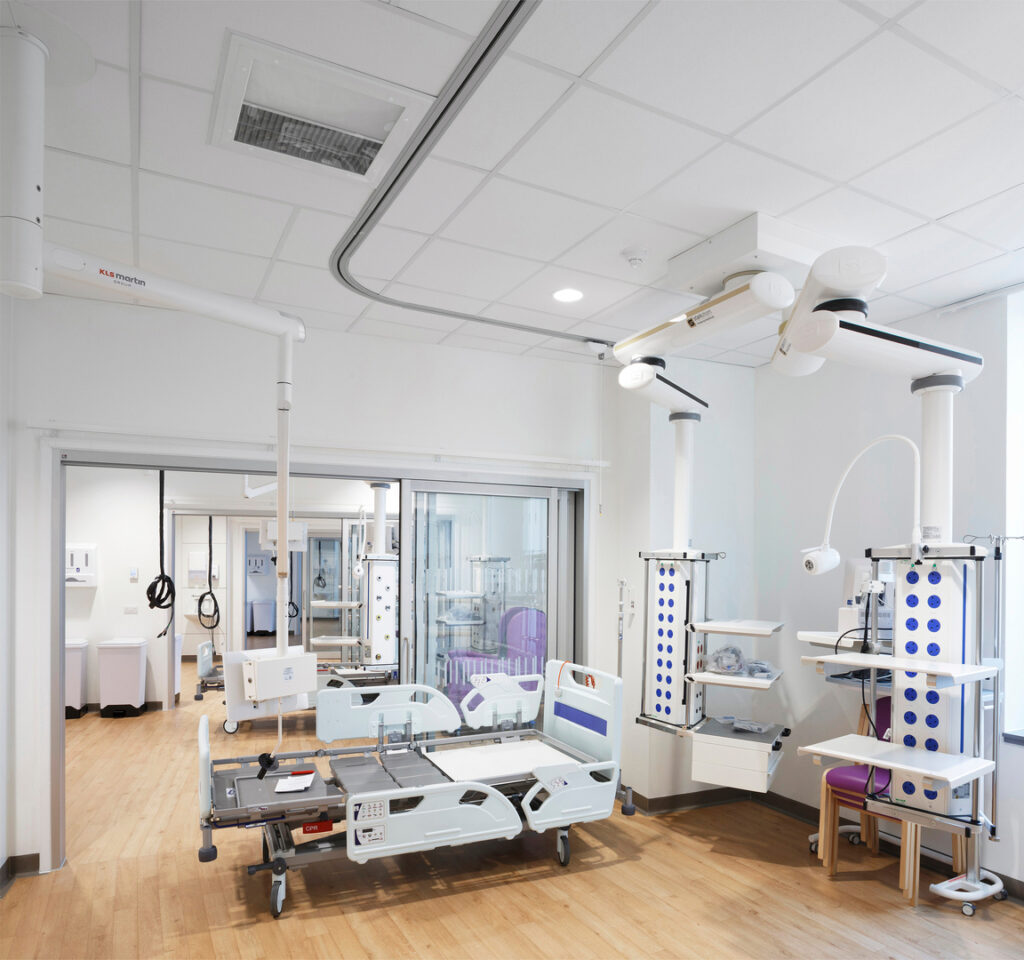
Rockfon’s primary strength lies in deep alignment with Health Technical Memorandum (HTM) 08-01, the definitive guidance on acoustics for UK healthcare. By providing Class A sound absorption, our solutions actively reduce reverberation times and background noise. This creates a “healing environment” where patients can rest without intrusion and where sensitive patient information—discussed at nurses’ stations or in consultation rooms—remains confidential, preserving dignity and data privacy.

Strategic alignment with the NHS Net Zero agenda
The NHS estate contributes significantly to the UK’s public sector carbon footprint so the commitment to become the world’s first Net Zero national health system presents real challenges.
Partnering with suppliers committed to sustainability is critical to the NHS reaching Net Zero by 2045. As part of ROCKWOOL® Group’s investment in sustainability in 2024, Rockcycle® was made more accessible in several markets including the UK and Ireland. This closed-loop recycling service enables contractors to return off-cuts and end-of-life Rockfon® products, which are recycled into new ROCKWOOL® Group stone wool products – reducing landfill and the use of virgin materials.”
For an NHS Trust or private provider, this turns a waste disposal cost into a sustainability credential, contributing directly to BREEAM credits and carbon reduction targets.
Rockfon products are made from stone wool (volcanic rock), an abundant and naturally durable material. Unlike materials that degrade or warp in humid hospital environments, stone wool remains dimensionally stable. This longevity reduces the replacement cycle—a vital factor for cash-strapped Trusts looking for long-term value rather than just low capital cost.

Infection Control and Hygiene
Post-pandemic, the scrutiny on building materials to support infection control is unprecedented. Rockfon’s MediCare® range is specifically engineered to meet these rigorous demands, complying with Health Building Note (HBN) 00-10 and offering a tiered approach to risk.
Crucially, stone wool is inorganic, meaning it provides no sustenance for harmful microorganisms, including MRSA. It is naturally resistant to mould and bacteria without relying on chemical fungicides that can degrade over time, pose toxicity risks and leach into the environment.

Beyond the Grid: Creating Healing Environments
While clinical function is paramount, the patient experience is increasingly defined by the quality of the environment. The sterile, intimidating hospital atmosphere is being replaced by design-led healing environments that reduce anxiety.
Using materials with a high light reflectance (in our case, up to 87%), draws natural light deeper into buildings. This not only reduces reliance on artificial lighting—lowering energy bills—but also regulates patient circadian rhythms, promoting better sleep patterns.
Flexibility is important too: looking beyond the traditional suspended grid unlocks design opportunities. Solutions such as Rockfon Eclipse acoustic islands have been used in projects like Morriston Hospital in Swansea and Thames Hospice to create visually stunning, non-institutional spaces. Acoustic rafts can be used to zone areas or add biophilic design elements without compromising air circulation or thermal mass cooling, bridging the gap between clinical rigour and hotel-like comfort.

A Proven Partnership
Ultimately, Rockfon’s value is evidenced by its track record. Major UK projects, including Luton & Dunstable, Brighton 3T’s and Bassetlaw Emergency Village, serve as testaments to their reliability. The construction supply chain is supported with technical expertise—offering NBS clauses, BIM objects, and on-site guidance to de-risk complex refurbishments as well as new build.
In an era where the UK healthcare estate must achieve more with less, Rockfon offers a holistic solution. They protect patients from noise, protect the budget through longevity, and protect the planet through circular manufacturing, making them an ideal partner for the future of healthcare construction.